
⚡ Quick Facts at a Glance
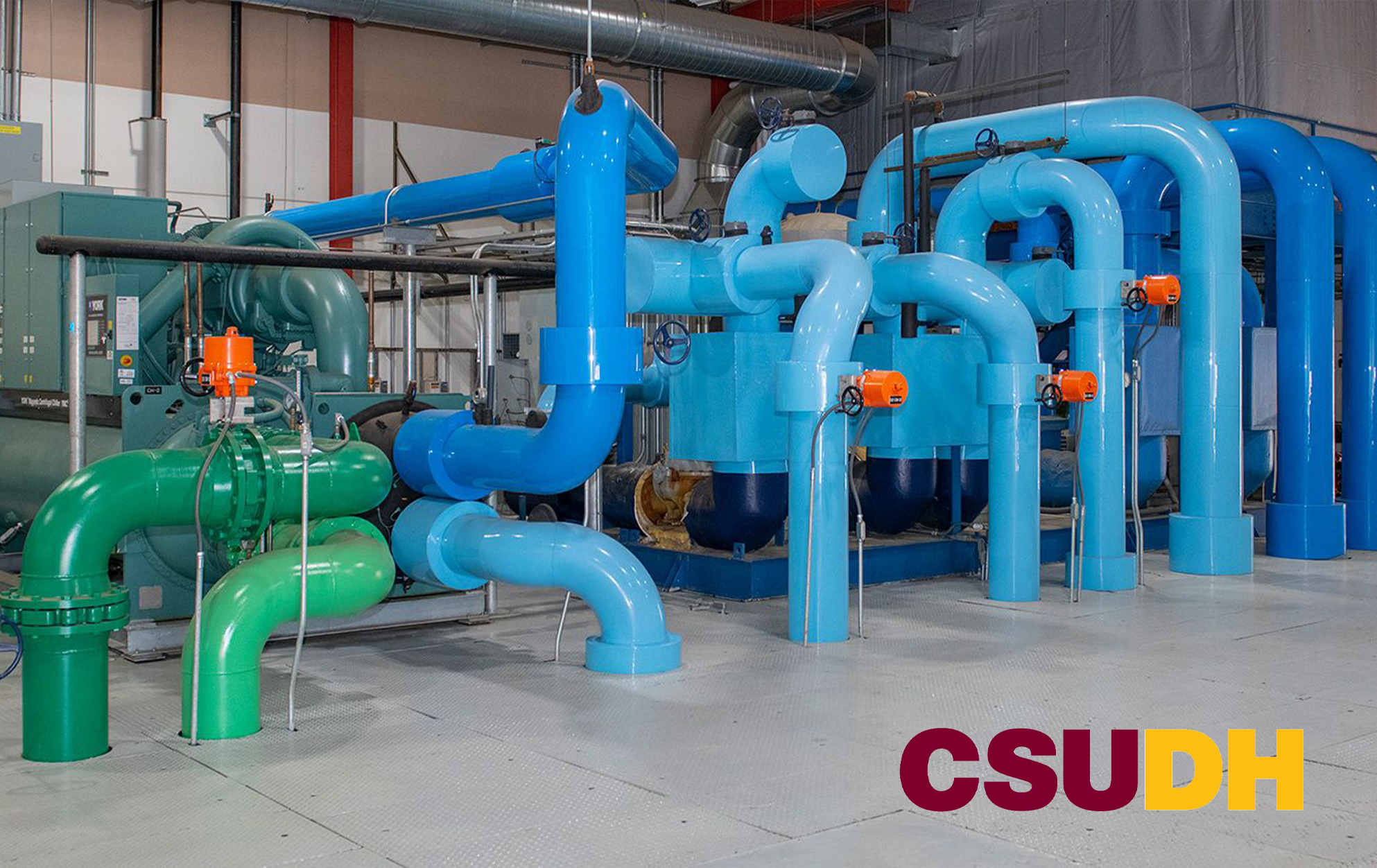
Facility: California State University, Dominguez Hills | 3 x JCI/York YMC2 water-cooled chillers (1,000-ton each) | 4 x Towertech cooling towers
BMS: Johnson Controls Metasys
Deployed: December 2023
Challenge: Commitment to reducing campus energy consumption through modern technology
Solution: Facil.AI autonomous chiller optimization via BMS integration
Results: 47% plant efficiency improvement | 0.19 kW/ton record performance
30% improved chiller performance (1,000-ton chillers delivering 1,300-1,400 tons)
Investment: Software-only, no capital equipment required
Estimated Annual Savings: $243,639 USD
Payback Period: 2 months
Overview
California State University Dominguez Hills (CSUDH) operates a central chilled water plant serving the campus, featuring three JCI/York YMC2 electric water-cooled chillers and four Towertech cooling towers with variable speed fans, all controlled by a Johnson Controls Metasys building management system (BMS). The facility management team maintains a core commitment to continually move the needle to reduce energy usage through the adoption of modern building technology.
To achieve measurable efficiency gains without major capital investment, the campus partnered with Facil.AI to optimize their three-chiller central plant. The autonomous AI agent integrates directly with the existing building management system, learning plant behavior and making continuous micro-adjustments to improve performance.
The results exceeded all expectations. Nine months after implementation, the chillers achieved record efficiency levels of 0.19 kW/ton, a performance threshold previously considered unattainable, surpassing ASHRAE 90.1's definition of "best" performance of 0.45 kW/ton by a significant margin.
The campus saves an estimated $243,639 USD from the AI enabled optimization. These savings have gone to help fund the installation of other campus sustainability improvements including heat pumps and smart energy valves.
The Challenge: Driving Continuous Energy Reduction in Campus Facilities
University facility teams face constant pressure to both reduce operational costs and improve sustainability. CSUDH sought the help of AI technology to improve central plant performance to save money and improve efficiency.
Operational Constraints
- Central plant with three chillers requiring coordinated optimization
- Need for improvements without disrupting campus operations
- Limited staff bandwidth for manual monitoring and adjustment
Financial Pressures
- Rising electricity costs impacting operating budgets
- Need for solutions with rapid payback periods
- Preference for operational expenditure over capital investment
Technical Challenges
- Chillers operating at baseline efficiency levels typical of industry standards
- Existing BMS providing data visibility but not optimization intelligence
- 2022 baseline efficiency at 0.86 kW/ton, roughly aligned with ASHRAE "typical" performance
Conventional energy conservation measures typically deliver incremental improvements requiring significant staff involvement or consultant expertise. CSUDH needed an approach that could deliver substantial gains autonomously.
The Facil.AI Agent : Autonomous Chiller Optimization
How Autonomous AI Differs from Traditional Energy Management
Traditional approaches to central plant efficiency rely on periodic retro-commissioning, manual setpoint adjustments, or consultant-led analysis. These methods require ongoing human expertise and produce results that degrade over time as conditions change.
Facil.AI takes a fundamentally different approach. The AI platform connects to the existing BMS and learns how the plant responds to varying loads, weather conditions, and operational patterns. After establishing a performance baseline, the system begins making continuous micro-adjustments, optimizing in real-time without requiring human intervention.
The CSUDH implementation included:
- Direct BMS integration - Connects to existing JCI Metasys infrastructure
- Autonomous learning - AI observes and learns plant behavior before introducing changes
- Continuous optimization - Dynamic setpoints automatically adjust every 5 minutes, not periodic tune-ups
- Holistic plant management - Optimizes the entire chilled water system, not individual components, striving for maximum efficiency on a plant level.
- Zero disruption - No equipment modifications, no staff training required
Deployed in December 2023, the AI began with Condenser Water Temperature Reset as the first optimization target. This process, typically hard-coded in the BMS as Outside Air Wet Bulb Temperature + 5°F, was converted to adaptive, autonomous control. The AI learns how to dynamically adjust condenser water temperature to balance cooling tower energy against chiller efficiency, finding optimal balance points in real-time.
The Results: Record-Breaking Efficiency Without Operational Disruption
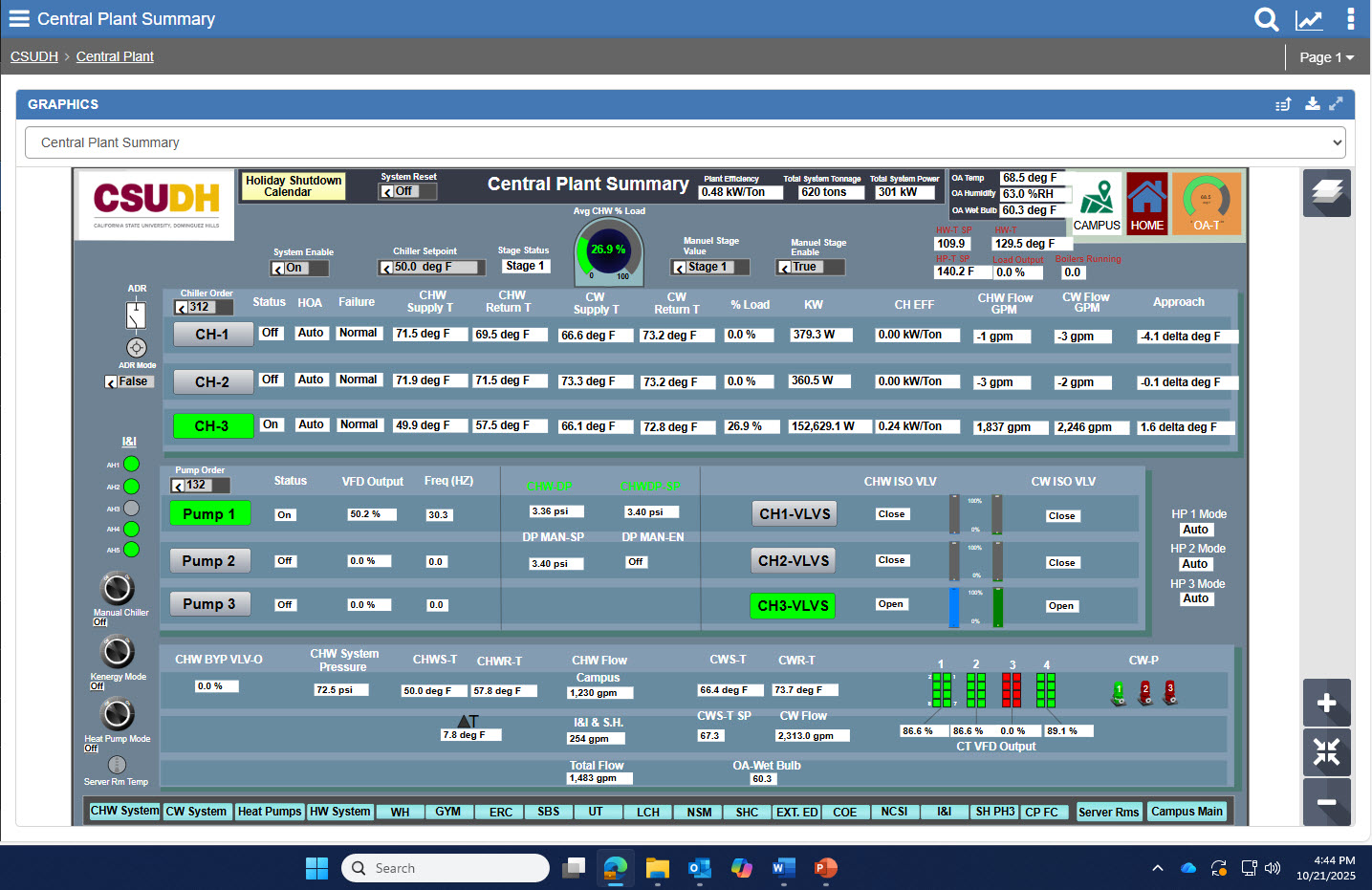
CSUDH documented dramatic improvements validated against industry benchmarks. The most striking outcome: performance gains continued even when key staff were away, demonstrating true autonomous operation.
Key Outcomes:
- 47% total plant efficiency improvement
- 2022 Baseline: 0.86 kW/ton
- Post-AI Average: 0.45 kW/ton
- Record chiller efficiency: 0.19 kW/ton (nearly 20 Coefficient of Performance)
- ASHRAE 90.1 defines "typical" chiller efficiency at 0.72 kW/ton
- ASHRAE 90.1 defines "best" chiller efficiency at 0.45 kW/ton
- CSUDH continues to achieve performance previously considered unattainable
- 30% improved chiller output
- 1,000-ton rated chillers performing as well as 1,300-1,400 ton chillers
- Producing over 600 tons of cooling while running at only 28% load
- Additional 300-400 tons capacity over equipment ratings
- $243,639 annual electricity savings
- Autonomous results - Performance gains achieved even while the Director of Central Plant Operations was on vacation
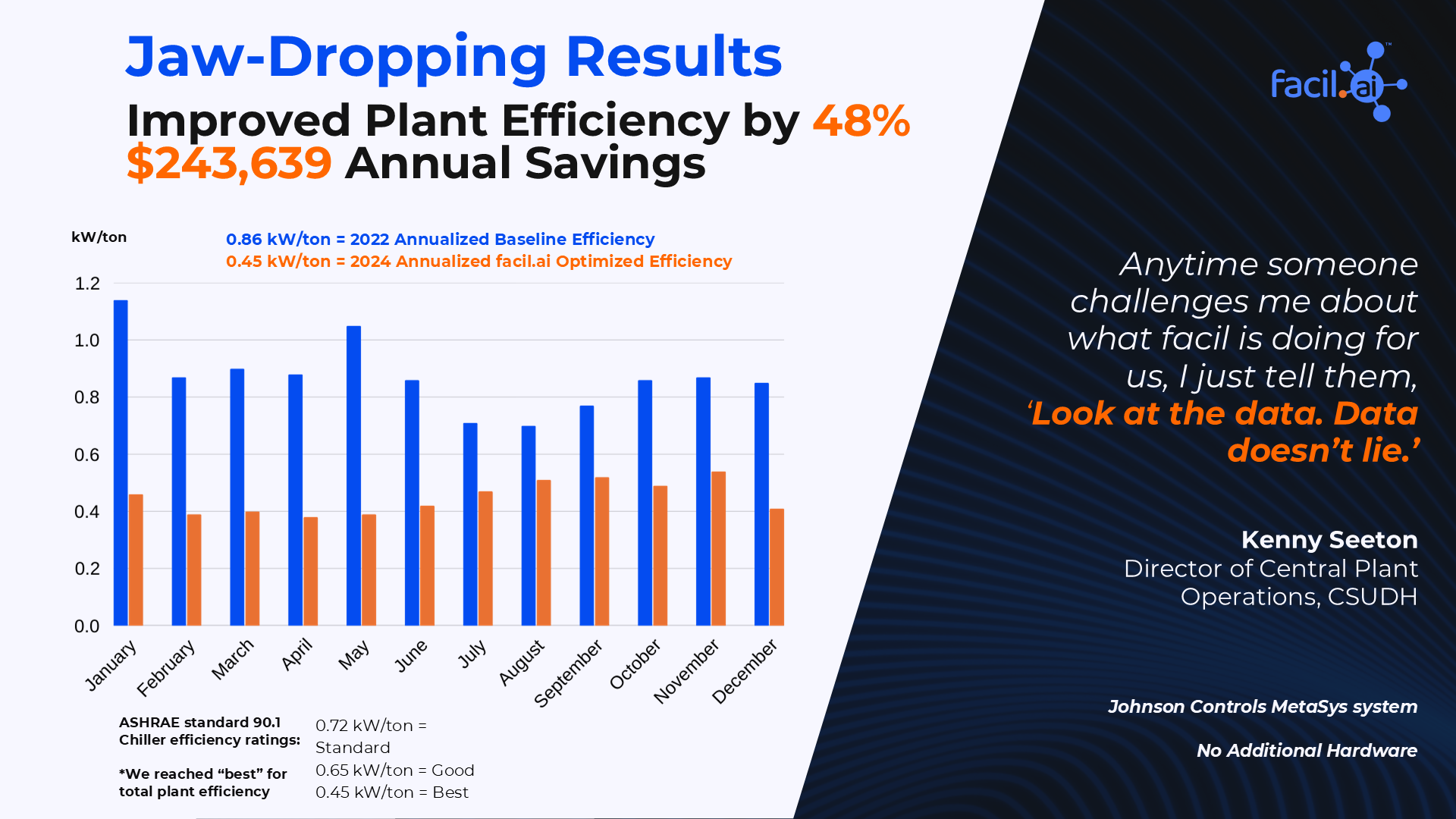
"Anytime someone challenges me about what Facil.AI is doing for us, I just tell them, 'Look at the data. Data doesn't lie.'" -- Kenny Seeton, Director of Central Plant Operations, CSUDH
AI Strategy: Adaptive Real-time Inference Learning
The Facil.AI platform uses Advanced Supervisory Control (ASC) powered by Liquid Neural Networks (LNNs) and deep reinforcement learning to develop and train a unique model for each piece of equipment. This Prescriptive AI approach (distinct from generative AI) follows a continuous cycle called Adaptive Real-time Inference Learning:
- Observe - Capture real-time telemetry from sensors and control points
- Plan - Use the equipment-specific neural model to determine optimal settings while respecting safety guardrails
- Act - Send precision commands to the BMS
- Learn - Analyze outcomes and refine the model using reinforcement learning
Unlike rule-based systems or generative AI that merely suggests actions, this Prescriptive AI takes autonomous action, improving with every minuscule change in temperature, load, or weather conditions. The platform makes dynamic setpoint adjustments every 5 minutes, compared to static rule-based systems that may only be reviewed annually.
How It Works
Initially, the system starts in learning mode. The AI agent safely observes the various settings in the central plant and learns over time how best to dynamically configure and adjust the system precisely to increase energy efficiency.
Within a couple of weeks, the AI agent has learned how to run the central plant and starts making micro adjustments to increase optimization.
Over time, the AI-agent continues to learn, constantly improving its own abilities and improving the efficiency and performance of the central plant, using a holistic approach to minimize energy use throughout the entire system.
Why Autonomous AI Succeeds Where Traditional Energy Conservation Measures Fall Short
Comparison: Conventional Approaches vs. AI-Driven Optimization
Periodic Retro-Commissioning:
- Requires hiring specialized consultants
- One-time optimization that degrades as conditions change
- Manual analysis and adjustment process
- Typical efficiency gains: 10-15%
- Results diminish between commissioning cycles
Manual BMS Optimization:
- Requires dedicated energy engineer or trained operators
- Time-intensive analysis of trending data
- Settings fixed until next manual review
- Results depend on staff availability and expertise
Facil.AI Autonomous Optimization:
- No specialized staff or consultants required
- Continuous learning and adaptation to changing conditions
- Dynamic optimization every 5 minutes, not periodically
- No retro-commissioning required
- Demonstrated results: 48% efficiency improvement, 0.19 kW/ton record for chiller efficiency
- Improvements sustained and compounded over time
The AI-agent continuously adapts and learns, training itself to improve efficiency. This approach delivers sustained performance gains that compound over time rather than degrading between interventions.
Conclusion: Redefining What's Possible in Chilled Water Plant Performance
CSUDH proves that deep reinforcement learning can push building systems beyond industry benchmarks that were previously thought to represent peak performance. A chiller achieving 0.19 kW/ton, nearly 20 Coefficient of Performance, establishes a new reference point for what intelligent building controls can deliver.
This wasn't accomplished through equipment upgrades or additional staffing. The neural network learned the plant's unique characteristics and continuously refined its approach, compounding efficiency gains over nine months.
For facility managers evaluating central plant energy management solutions, CSUDH demonstrates that machine learning for HVAC is no longer experimental. It's delivering measurable, bankable results that exceed even optimistic projections.
Frequently Asked Questions (FAQs)
None. The system is fully autonomous after initial setup. Your facilities team continues normal operations while the AI optimizes in the background. No training, ongoing management, or specialized energy engineering expertise is required. Results are delivered whether your team is actively monitoring or not.
No. Facil.AI operates within manufacturer specifications, optimizing control sequences through your existing BMS without modifying equipment hardware.
Initial setup: 1-2 days for BAS integration and system configuration
Observation period: 10-14 days as AI learns your system
Optimization: Begins immediately after observation, reaching full optimization within 30-45 days
Savings are measured through direct metering data from your BAS and utility meters. The platform provides continuous monitoring and reporting of energy performance metrics including kW/ton efficiency, energy consumption, and estimated cost savings. An open API through the Independent Data Layer (IDL) allows data export for independent verification or integration with fault detection and maintenance tracking systems.
Yes. The platform is designed for infinite scalability. New sites are automatically integrated within minutes and begin saving energy immediately. The AI agents can manage single buildings or portfolios with hundreds of thousands of locations simultaneously, with no additional infrastructure required as you grow.
Most implementations achieve payback in under six months. For large portfolios, monthly savings typically exceed subscription costs from the first month of full deployment.
No. The AI operates autonomously but amplifies your team's effectiveness rather than replacing them. It handles continuous optimization in the background, freeing your team to focus on strategic priorities rather than manual monitoring and reactive troubleshooting.