

⚡ Quick Facts at a Glance
Facility: California State University, Channel Islands | 1.3M sq ft | 21 buildings
Challenge: Post-COVID budget cuts, reduced staff, rising energy costs, no capital for upgrades
Solution: Facil.AI autonomous chiller optimization with Building Automation System (BAS) integration
Results: 48% efficiency improvement (1.15 to 0.6 kW/ton) in 45 days
Investment: Software-only solution, no capital equipment, no staff training required
Payback Period: Under 6 months
Overview
California State University, Channel Islands (CSUCI), a small public campus in Southern California, was facing mounting pressure to reduce energy costs. Post COVID enrollment-declines had reduced funding, forcing the university to rethink facility operations without the benefit of a budget for major capital upgrades.
The facility has 21 buildings covering 1.3 million square feet. Most of this space is conditioned by a central plant with two JCI York chillers (620 tons and 680 tons), controlled by an Automated Logic Building Automation System (BAS).
Guided by Apex Consulting, the facilities team at CSUCI implemented Facil.AI to improve chiller efficiency and performance.
Within 45 days the campus improved plant efficiency by 48%, improved visibility into plant data, and optimized chiller performance.
The Challenge: Increased Operating Costs in a Real-World Campus Environment
Like many small universities, enrollment drives funding. When enrollment is down, budgets are cut. CSUCI faced this very challenge, specifically:
Operational Constraints
- No dedicated energy engineer to monitor and optimize systems
- Lean team already stretched thin managing day-to-day operations across 21 buildings
- No time or resources for manual Energy Management System (EMS) adjustments
- Skepticism about adding new technology that requires training or ongoing management
Financial Pressures
- No available budget for capital-intensive solutions like equipment replacement
- Rising electricity costs eating into already-reduced operating budgets
- Demand for staff reductions
- Need for urgent cost reduction without multi-year payback periods
Technical Challenges
- Existing Building Automation System (BAS) provided data but not optimization
- Chillers running at manufacturer defaults, not optimized for actual campus conditions
- Limited visibility into historical performance trends
The Facil.AI Solution: "Human Out of the Loop" Chiller Optimization
How Facil.AI Differs from Traditional Approaches
While conventional Energy Conservation Measures (ECMs) like retro or monitoring based commissioning (MBCx) require consultants, extensive labor, and ongoing manual adjustments, Facil.AI provides unsupervised continuous autonomous optimization. Traditional building management systems provide visibility and control, but still require human expertise to make optimization decisions. Facil.AI removes this dependency entirely.
Rather than investing in time-consuming or expensive solutions, CSUCI implemented Facil.AI as a software-only HVAC optimization solution. This approach included:
- Direct BAS integration - Works with existing Automated Logic WebCtrl system, no hardware changes
- Fully autonomous optimization - AI agent operates independently, no ongoing human input required
- Nearly immediate results - Measurable improvements within 45 days, no employee training needed
- Reinforces equipment limits - no system overrides, maintains comfort
- Non-invasive implementation - No impact on equipment warranties or existing maintenance schedules
The AI begins by observing, then the AI-agent introduces small, incremental adjustments, continuously measuring outcomes and refining its approach.

The Results: Measurable Energy Savings Without Disruption
Within one month, the university saw a dramatic reduction in plant energy use, validated by the local utility, Southern California Edison.
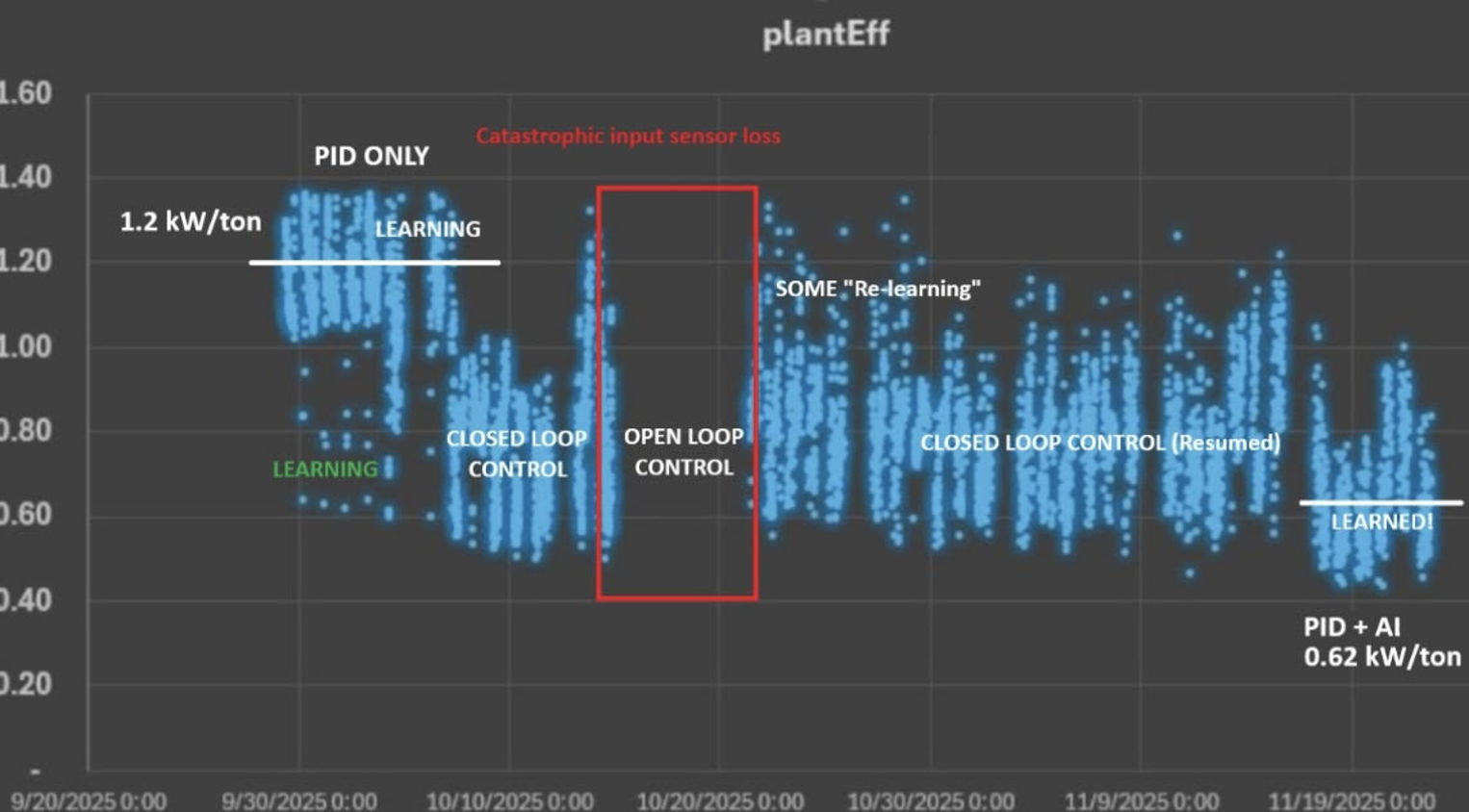
Key Outcomes:
- 48% increased plant efficiency
- Before AI Average Efficiency = 1.15 kW/ton
- After AI Average Efficiency = 0.6 kW/ton
- More reliable historical data visibility via the Facil.AI API
- Improving chiller performance, reducing the need to operate both chillers simultaneously
- Reduced overall energy use resulting in less energy spend
The CSUCI leadership has been most impressed with the reliability of the Facil.AI integration and results.
“Things break. You want something that is reliable and predictable. Facil.AI delivers that. You get predictability and significant energy savings.” --Aaron Hastings, Smart Building Consultant, Apex Consulting, CSUCI
Why AI Succeeds Where Other Energy Conservation Measures Fail
Comparison: Traditional ECMs vs. AI-Driven Optimization
Traditional Retro-Commissioning:
- Requires hiring specialized consultants
- One-time optimization that degrades over time
- Manual adjustments needed as conditions change
- Typical savings: 10-15%
- Payback: 1-3 years
Manual BAS Optimization:
- Requires dedicated energy engineer or trained staff
- Time-intensive analysis and adjustment
- Risk of human error or suboptimal settings
- Inconsistent results depending on staff availability
Facil.AI Autonomous Optimization:
- Continuous optimization that adapts to changing conditions
- Fully autonomous operation
- Demonstrated savings: 48% efficiency improvement at CSUCI
- Payback: Under 6 months
Most traditional Energy Conservation Measures (ECMs) depend heavily on facility teams to implement and monitor. For campuses already operating with a lean staff, this creates risk and inconsistencies.
Facil.AI removes this dependency by autonomously optimizing central plant performance with no additional workload for the existing team.
Conclusion: A Smart Campus Energy Solution
CSUCI’s results demonstrate a new model for campus energy management where automation delivers results.
By allowing AI to learn and operate quietly in the background, universities can reduce energy costs, improve operational confidence, and adapt to financial constraints without sacrificing performance.
Frequently Asked Questions (FAQs)
None. The system is fully autonomous after initial setup. Your facilities team continues normal operations while the AI optimizes in the background. No training, ongoing management, or specialized energy engineering expertise is required. Results are delivered whether your team is actively monitoring or not.
No. Facil.AI operates within manufacturer specifications, optimizing control sequences through your existing BMS without modifying equipment hardware.
Initial setup: 1-2 days for BAS integration and system configuration
Observation period: 10-14 days as AI learns your system
Optimization: Begins immediately after observation, reaching full optimization within 30-45 days
Savings are measured through direct metering data from your BAS and utility meters. The platform provides continuous monitoring and reporting of energy performance metrics including kW/ton efficiency, energy consumption, and estimated cost savings. An open API through the Independent Data Layer (IDL) allows data export for independent verification or integration with fault detection and maintenance tracking systems.
Yes. The platform is designed for infinite scalability. New sites are automatically integrated within minutes and begin saving energy immediately. The AI agents can manage single buildings or portfolios with hundreds of thousands of locations simultaneously, with no additional infrastructure required as you grow.
Most implementations achieve payback in under six months. For large portfolios, monthly savings typically exceed subscription costs from the first month of full deployment.
No. The AI operates autonomously but amplifies your team's effectiveness rather than replacing them. It handles continuous optimization in the background, freeing your team to focus on strategic priorities rather than manual monitoring and reactive troubleshooting.