

⚡ Quick Facts at a Glance
Facility: National Small-Box Discount Retailer | 1,800+ stores | 5,000+ rooftop units
Challenge: Manual oversight of 1,000+ stores with reactive energy management, comfort complaints, high truck roll costs
Solution: Facil.AI Advanced Supervisory Control (ASC) with autonomous RTU optimization
Integration: Cloud-to-cloud API with existing smart thermostat BMS, no new on-site hardware
Deployment: June 2022 (ongoing)
Results: 503% average monthly ROI | 19% more savings than incumbent AI | 40% fewer alarms and truck rolls
Investment: OpEx SaaS model, no capital equipment required
Estimated Annual Savings: $2.5 Million USD | 19.5 Million kWh
Payback Period: Immediate (monthly savings exceed SaaS fees by 5x)
Overview
A national small-box discount retailer operating over 1,800 stores across the United States faced a common challenge: how to manage energy costs across a distributed portfolio without adding headcount or complexity.
Before implementing AI optimization, the retailer employed two dedicated staff plus an outside consultant to manually monitor building management systems across 1,000 stores. The approach was entirely reactive, responding to energy spikes, comfort complaints, and maintenance alerts after problems occurred. There were no proactive energy conservation measures in place.
The retailer evaluated AI solutions through a competitive 90-day pilot: twenty stores managed by their incumbent BMS vendor's "AI demand management" partner versus twenty stores managed by Facil.AI. The results were decisive. Facil.AI saved 19% more energy than the competing solution, winning the contract for portfolio-wide deployment.
Since full implementation in June 2022, the retailer has achieved average monthly energy savings of 10%, translating to $250,000 per month in reduced electricity costs. The portfolio has more than doubled in size since deployment, with new stores automatically onboarded and optimized within minutes.
The Challenge: Scaling Energy Management Across a Growing Retail Portfolio
Multi-site retailers face a unique operational challenge. Each store has its own HVAC equipment, local conditions, and occupancy patterns. Managing energy consumption at scale traditionally requires either significant staff investment or accepting suboptimal performance.
Operational Constraints
- Two dedicated staff plus an external consultant monitoring 1,000 stores
- Reactive approach: responding to problems after they occur
- No proactive energy conservation measures in place
- Manual oversight of front-end systems across the portfolio
- Portfolio growth outpacing management capacity
Financial Pressures
- Energy costs multiplying as store count increased
- Consultant and staffing costs for manual monitoring
- Truck rolls for comfort and maintenance issues eroding margins
- Need for a solution that scales without adding headcount
- Requirement for measurable ROI, not just "actionable insights"
Technical Challenges
- 5,000+ rooftop units with varying configurations and conditions
- Zone-by-zone variations impossible to address manually at scale
- Traditional BMS providing control but not optimization
- Comfort complaints impacting customer and employee experience
- Existing "AI" solutions requiring human intervention to implement recommendations
The retailer needed technology that would take action autonomously, not simply surface insights that required human follow-through.
The Facil.AI Solution: Autonomous RTU Optimization at Portfolio Scale
How Prescriptive AI Differs from "Actionable Insights"
Most energy management platforms provide dashboards, alerts, and recommendations. They surface insights but require facility teams to interpret data and implement changes. For a retailer managing thousands of stores, this approach simply shifts work rather than eliminating it.
Facil.AI operates differently. The platform deploys prescriptive AI-agents using Advanced Supervisory Control (ASC) that observe system behavior, plan optimization strategies, execute changes through the BMS, and learn from results. Unlike generative AI that makes suggestions, the prescriptive AI of Facil.AI takes action autonomously within strict guardrails, eliminating the gap between insight and implementation.
System Architecture
The deployment leveraged the retailer's existing smart thermostat infrastructure through cloud-to-cloud API integration. No on-site hardware from Facil.AI was required, enabling rapid deployment across the portfolio.
The retailer's deployment included:
- Cloud-to-cloud API integration - Connects to existing smart thermostat BMS with no on-site hardware
- Plug-and-play onboarding - New stores integrated automatically within minutes
- Zone-level optimization - Each zone modeled individually using reinforcement learning
- Building as a Battery (BaaB) - Thermal mass leveraged for demand management
- Adaptive Real-time Inference Learning - AI-agents observe, plan, act, and learn continuously
- Infinite scalability - Portfolio doubled with zero additional infrastructure
Zone-Level Intelligence with Adaptive Real-time Inference Learning
The AI uses Adaptive Real-time Inference Learning, a continuous cycle where AI-agents:
- Observe real-time data from each zone
- Plan the optimal strategy based on current conditions
- Act by sending commands to the BMS
- Learn from the resulting outputs to improve future decisions
The platform implements Building as a Battery (BaaB), treating thermal mass as an energy storage asset. Rather than optimizing each store as a single unit, the AI builds a unique model for every zone within every store. Each zone is optimized individually, accounting for local conditions, occupancy patterns, and equipment characteristics.
There is one model per zone, not per building. The AI optimizes each unique zone relentlessly, reducing compressor runtime for electricity savings while maintaining precise comfort levels. Critically, the AI does not cycle fans on/off or raise setpoints outside the comfort range.
Within a couple of weeks, the AI agents learn how to optimize each RTU and begin making continuous adjustments. The process requires no intervention from the retailer's facilities team.
The Results: Validated Savings That Compound with Growth
The 90-day competitive pilot established clear performance differentiation. Portfolio-wide deployment delivered sustained results that exceeded initial projections.
Key Outcomes:
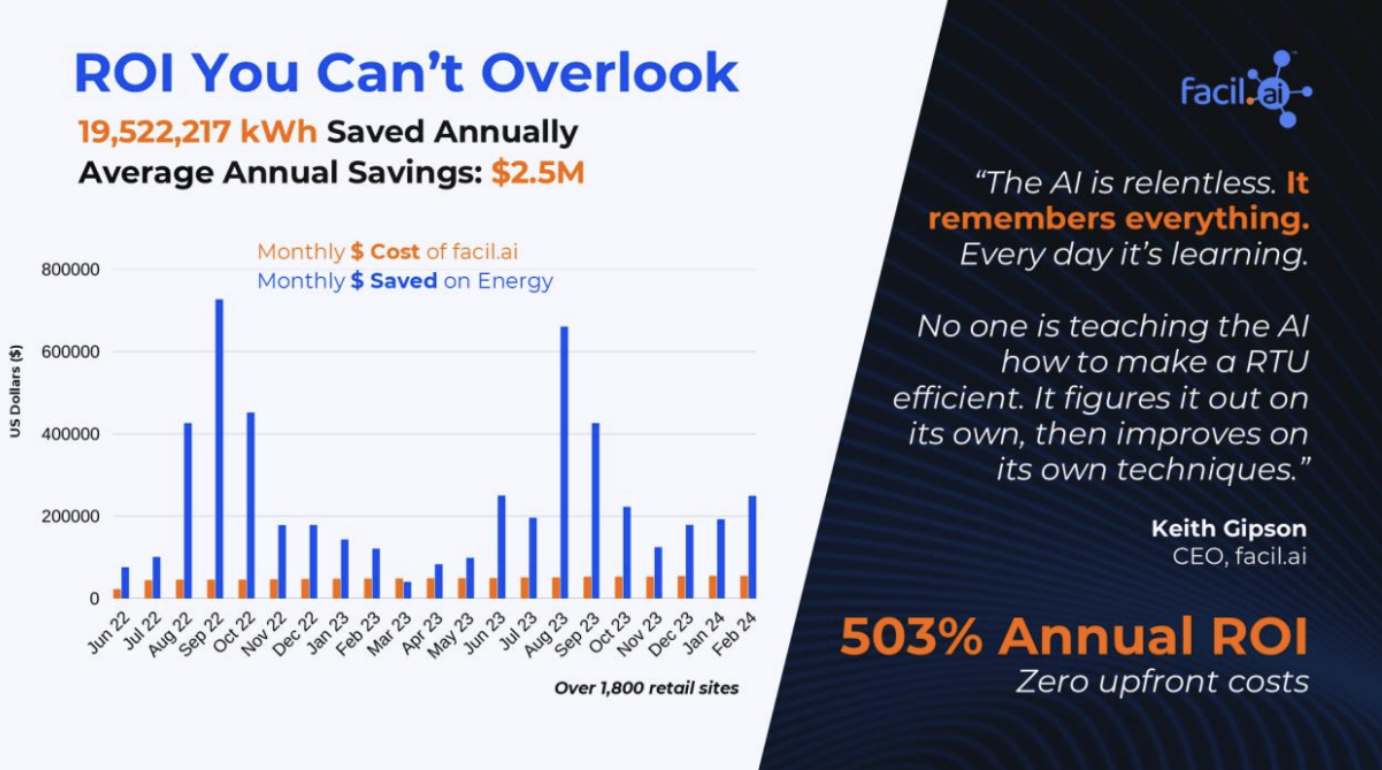
- 503% average monthly ROI
- Monthly SaaS fee vs. monthly savings
- Savings consistently exceed costs by more than 5x
- 19% more energy saved than incumbent AI solution
- Head-to-head competitive pilot
- 20 stores each, 90-day evaluation
- $2.5 Million annual savings
- $250,000 average monthly reduction
- Validated across the full portfolio
- 19.5 Million kWh saved annually
- Equivalent to powering a small data center for a year
- 30% improvement in comfort settings
- Better customer and employee experience
- 40% reduction in alarms and truck rolls
- Side effect of improved system efficiency and precision control
- Automatic scalability
- Portfolio doubled since implementation
- New stores optimized within minutes of onboarding
Based on these results, the retailer extended the contract for an additional three years.
"Results from the pilot were astounding. The Facil.AI team brought benefit after benefit. After a while, I just told them, 'You HAD me at 19%! (energy savings). If you keep saving me money like this, we are never going to cancel.'" -- VP of Procurement
Why Prescriptive AI Succeeds Where "Actionable Insights" Fall Short
Comparison: Traditional Approaches vs. Autonomous Optimization
Manual Portfolio Monitoring:
- Required 2 dedicated staff plus external consultant
- Reactive response to alerts and complaints
- Could not scale with portfolio growth
- No proactive optimization
- Results depended on staff bandwidth and expertise
Incumbent "AI Demand Management":
- Theoretical AI providing actionable insights
- Required human intervention to implement changes
- 19% less effective than Facil.AI in head-to-head testing
- Gap between insight and action reduced effectiveness
Facil.AI Advanced Supervisory Control (ASC):
- Prescriptive AI: takes action, not just provides recommendations
- Autonomous operation with strict safety guardrails
- Demonstrated 19% better performance than competing AI
- 503% monthly ROI across portfolio
- Uses reinforcement learning for continuous self-improvement
- Contract extended for 3 additional years based on results
- Infinitely scalable: portfolio doubled with no additional infrastructure
The distinction between "actionable insights" and "autonomous action" proved decisive. Technology that requires human implementation cannot scale across thousands of locations. AI that takes action independently delivers compounding returns.
Conclusion: Scalable Energy Optimization for Distributed Portfolios
This retailer's results demonstrate a new model for portfolio energy management: AI that takes action autonomously, scales without adding headcount, and delivers validated returns from day one.
The platform proved its value through competitive pilot, sustained performance through portfolio growth, and earned a three-year contract extension based on results. For retailers managing distributed locations, autonomous RTU optimization represents technology that delivers compounding returns without demanding attention.
Next phase: The retailer plans to expand Facil.AI's role into preventative maintenance analysis, leveraging the platform's continuous monitoring to predict equipment issues before they impact operations.
Frequently Asked Questions (FAQs)
None. The system is fully autonomous after initial setup. Your facilities team continues normal operations while the AI optimizes in the background. No training, ongoing management, or specialized energy engineering expertise is required. Results are delivered whether your team is actively monitoring or not.
No. Facil.AI operates within manufacturer specifications, optimizing control sequences through your existing BMS without modifying equipment hardware.
Initial setup: 1-2 days for BAS integration and system configuration
Observation period: 10-14 days as AI learns your system
Optimization: Begins immediately after observation, reaching full optimization within 30-45 days
Savings are measured through direct metering data from your BAS and utility meters. The platform provides continuous monitoring and reporting of energy performance metrics including kW/ton efficiency, energy consumption, and estimated cost savings. An open API through the Independent Data Layer (IDL) allows data export for independent verification or integration with fault detection and maintenance tracking systems.
Yes. The platform is designed for infinite scalability. New sites are automatically integrated within minutes and begin saving energy immediately. The AI agents can manage single buildings or portfolios with hundreds of thousands of locations simultaneously, with no additional infrastructure required as you grow.
Most implementations achieve payback in under six months. For large portfolios, monthly savings typically exceed subscription costs from the first month of full deployment.
No. The AI operates autonomously but amplifies your team's effectiveness rather than replacing them. It handles continuous optimization in the background, freeing your team to focus on strategic priorities rather than manual monitoring and reactive troubleshooting.