
⚡ Quick Facts at a Glance
Facility: National Retail Chain | Nearly 1,000 locations | Over 6,000 rooftop units
Challenge: Managing HVAC performance across hundreds of distributed stores without increasing facilities staff workload
Solution: Facil.AI Advanced Supervisory Control (ASC) with autonomous RTU optimization
Integration: Cloud integration with existing network-controlled thermostats, no new hardware required
Estimated Annual Savings: Over $3 Million
Environmental Impact: 3,000+ metric tons of CO2 avoided
Measurement & Verification: IPMVP Option C
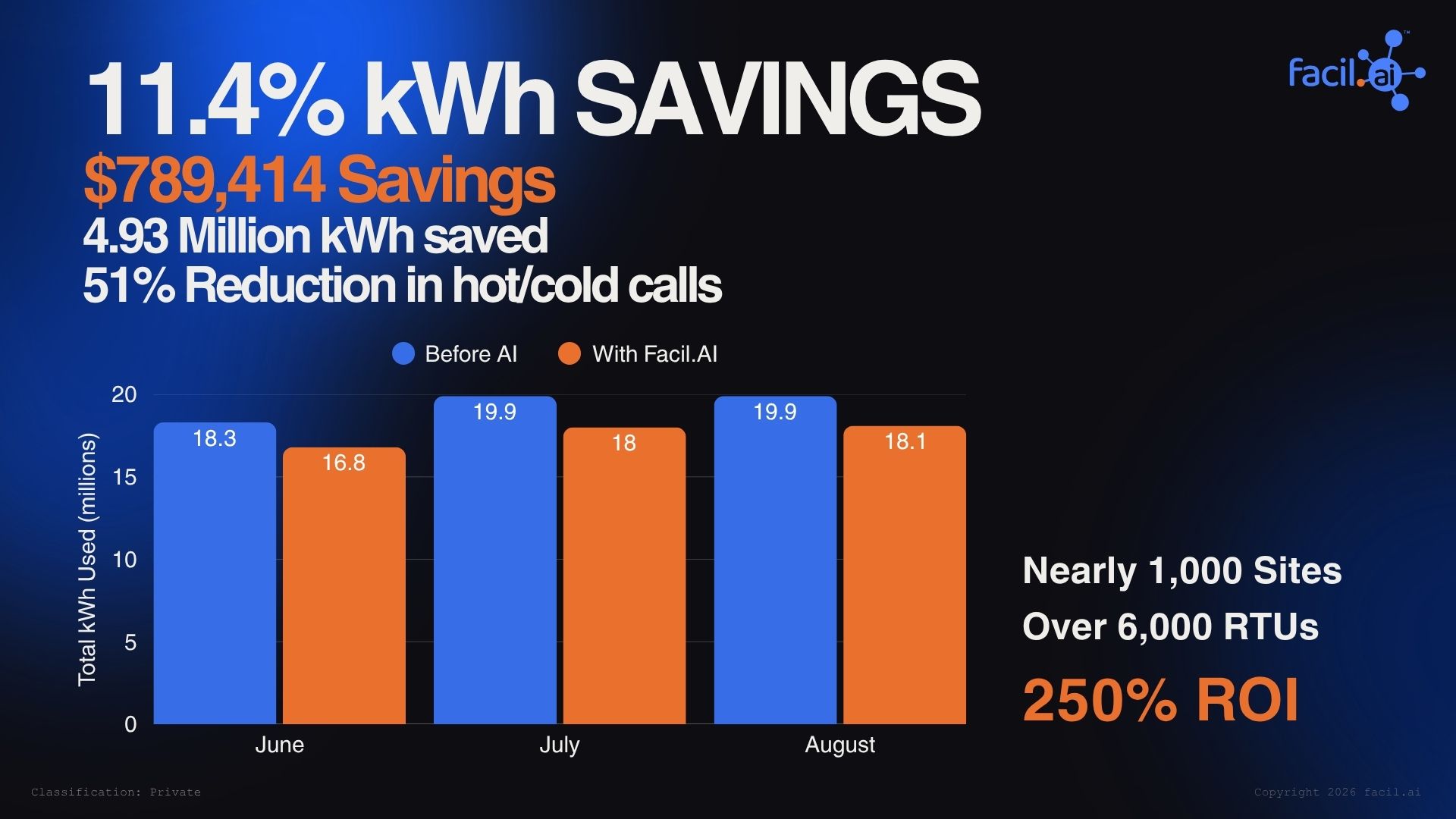
Results: 11.4% kWh reduction | $789,414 saved in 90 days | 51% Reduction in hot/cold calls
Overview
A national retail chain operating thousands of stores across the United States faced a familiar operational challenge: how to reduce energy costs without impacting comfort across diverse building footprints.
Each store relied on network-controlled thermostats connected to rooftop HVAC units, creating a large distributed portfolio. While the existing infrastructure provided basic control and visibility, it did not actively optimize performance.
Manual oversight of the thousands of systems was not feasible. Facilities teams were focused on maintaining operations and responding to issues rather than continuously adjusting HVAC behavior for efficiency. The retailer needed a solution that could reduce energy consumption, preserve staff bandwidth, maintain comfortable temperatures, and deliver measurable financial returns quickly.
The retailer launched Facil.AI to optimize HVAC systems for nearly 1,000 locations with over 6,000 rooftop units without requiring human oversight.
‼️The retailer saved $789,414 on energy bills in only 90 days while reducing hot/cold calls by 51%.
The Challenge: Reducing Energy Costs Without Increasing Workload
Retail chains operating hundreds of locations face a structural problem: energy management does not scale well with traditional approaches.
Each location has its own equipment, climate conditions, occupancy patterns, and operational schedules. Monitoring and optimizing these systems manually across hundreds of buildings requires significant labor and coordination.
Operational Constraints
- Facilities teams already operating at full capacity
- Limited ability to manually monitor HVAC performance across hundreds of sites
- Network thermostats providing control but not optimization
- Reactive response to comfort complaints and equipment issues
- Portfolio size too large for manual tuning
Business Drivers
Several strategic priorities drove the retailer’s decision to explore autonomous optimization:
Operational Efficiency
- Preserve facilities staff bandwidth
- Avoid adding headcount
Financial Responsibility
- Reduce operating expenses across the portfolio
- Minimize expensive service calls
- Deliver fast payback on any new technology
Customer and Employee Experience
- Maintain consistent comfort in stores
- Avoid aggressive energy strategies that compromise the shopping environment
The retailer needed technology that could deliver measurable results quickly while operating independently of facility staff involvement.
The Facil.AI Solution: Autonomous RTU Optimization
It took Facil.AI less than a week to deploy an AI-driven Advanced Supervisory Control (ASC) solution to nearly 1,000 stores.
Rather than generating dashboards or recommendations that require human action, the platform used prescriptive AI agents that continuously:
- Observed building and equipment behavior
- Planned optimal HVAC strategies
- Executed control adjustments
- Learned from system response
This process repeats continuously, allowing the AI to improve performance over time without requiring facility staff to intervene.
Deployment Architecture
The pilot leveraged the retailer’s existing infrastructure:
- Network-controlled thermostats already installed
- Cloud-based integration
Because the platform operates through a software gateway into the existing control network, the deployment required no operational disruption and was implemented in less than a week.
Autonomous Optimization
The AI agents continuously evaluate system behavior and environmental conditions, and adjust HVAC operation to reduce runtime while maintaining comfort.
The Results: Measurable Savings in Just 90 Days
Autonomous AI can deliver meaningful operational improvements at scale without increasing workload for facility teams.
Key Outcomes
✅Energy Savings
- 11.4% average reduction in electricity consumption
✅Financial Impact
- $789,414 saved in 90 days
- Estimated annual savings to exceed $3 million
✅Environmental Impact
- Over 3,000 metric tons of CO₂ emissions avoided
✅Comfort Improvements
- 51% Reduction in hot/cold calls
- Store temperatures remained tightly controlled
- No AI-controlled zone exceeded 72.3°F
These results proved that energy savings could be achieved without sacrificing customer experience. Energy performance was validated using IPMVP Option C, a widely accepted methodology for evaluating whole-facility energy performance
Additional Operational Benefits
Beyond direct energy savings, the portfolio benefits from several secondary advantages.
Improved Comfort Stability
AI-controlled systems maintain tighter temperature ranges than manual control approaches.
Operational Simplicity
Facilities teams are not required to review dashboards or implement recommendations.
Portfolio Scalability
The system can manage HVAC performance across hundreds of sites simultaneously without additional staff involvement.
Conclusion: Autonomous Energy Management at Scale is a Reality
Large retail portfolios can significantly reduce energy consumption without increasing operational complexity. By deploying autonomous prescriptive AI, the retailer achieved:
- Rapid financial returns
- Measurable sustainability improvements
- Improved comfort stability
- Zero increase in facilities workload
As retail portfolios continue to expand, solutions that rely on manual adjustments become increasingly unsustainable.
Autonomous optimization offers a new model for managing energy performance at scale. Buildings continuously improve their own efficiency without demanding attention from already busy facility teams.
Frequently Asked Questions (FAQs)
None. The system is fully autonomous after initial setup. Your facilities team continues normal operations while the AI optimizes in the background. No training, ongoing management, or specialized energy engineering expertise is required. Results are delivered whether your team is actively monitoring or not.
No. Facil.AI operates within manufacturer specifications, optimizing control sequences through your existing BMS without modifying equipment hardware.
Initial setup: 1-2 days for BAS integration and system configuration
Observation period: 10-14 days as AI learns your system
Optimization: Begins immediately after observation, reaching full optimization within 30-45 days
Savings are measured through direct metering data from your BAS and utility meters. The platform provides continuous monitoring and reporting of energy performance metrics including kW/ton efficiency, energy consumption, and estimated cost savings. An open API through the Independent Data Layer (IDL) allows data export for independent verification or integration with fault detection and maintenance tracking systems.
Yes. The platform is designed for infinite scalability. New sites are automatically integrated within minutes and begin saving energy immediately. The AI agents can manage single buildings or portfolios with hundreds of thousands of locations simultaneously, with no additional infrastructure required as you grow.
Most implementations achieve payback in under six months. For large portfolios, monthly savings typically exceed subscription costs from the first month of full deployment.
No. The AI operates autonomously but amplifies your team's effectiveness rather than replacing them. It handles continuous optimization in the background, freeing your team to focus on strategic priorities rather than manual monitoring and reactive troubleshooting.